The Man and the Biosphere (MAB) Programme
The Man and the Biosphere (MAB) programme is an intergovernmental scientific programme that aims to establish a scientific basis for enhancing the relationship between people and their environments. It combines the natural and social sciences with a view to improving human livelihoods and safeguarding natural and managed ecosystems, thus promoting innovative approaches to economic development that are socially and culturally appropriate and environmentally sustainable.
Biosphere reserves are ‘learning places for sustainable development’. They are sites for testing interdisciplinary approaches to understanding and managing changes and interactions between social and ecological systems, including conflict prevention and management of biodiversity. Biosphere reserves include terrestrial, marine and coastal ecosystems.
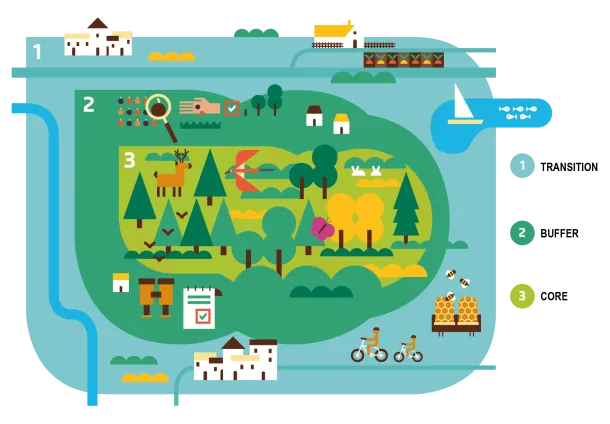
Every biosphere reserve consists of three zones:
Core areas (3)
They comprise a strictly protected zone that contributes to the conservation of landscapes, ecosystems, species and genetic variation
Buffer zones (2)
They surround or adjoin the core area(s), and are used for activities compatible with sound ecological practices that can reinforce scientific research, monitoring, training and education.
Transition area (1)
The transition area is where community’s foster socio-culturally and ecologically sustainable economic and human activities.